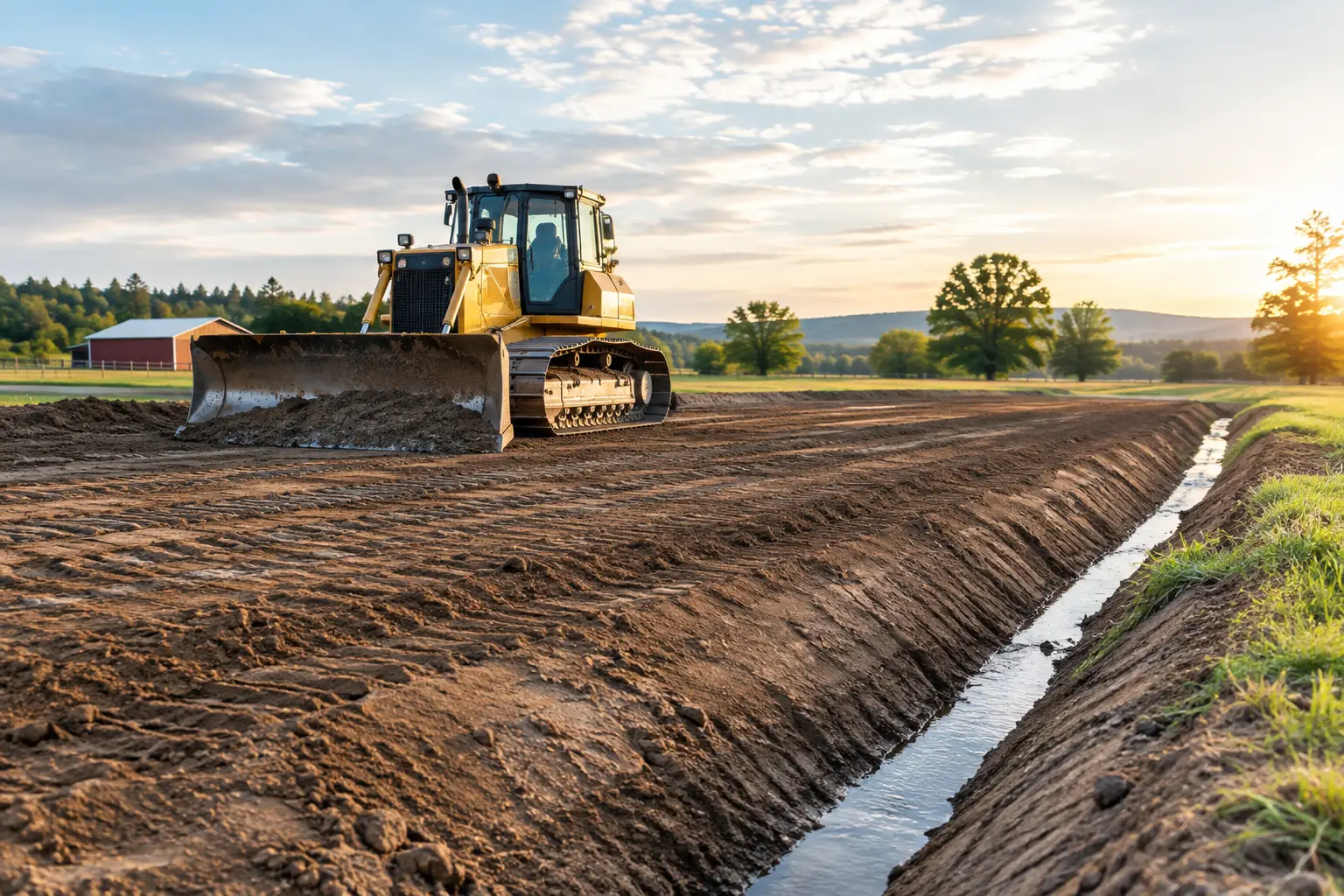
Land Grading for Drainage on Rural Property

A hard rain can show you more about a property in one afternoon than a dry season shows in six months. Water collecting beside a home pad, washing ruts into a gravel driveway, or standing in a pasture is not just an inconvenience. Left alone, it can weaken access roads, soften building areas, limit usable acreage, and create ongoing maintenance work.
Land grading for drainage gives water a planned route across the property instead of allowing it to settle where it causes trouble. For rural landowners, the goal is usually straightforward: keep water moving away from structures and travel areas while preserving the natural function of the land.
Why drainage problems start with the shape of the land
Water follows the lowest available path. On a wooded or undeveloped parcel, that path may be hidden by brush, leaf cover, old logging trails, or uneven ground. Once trees are cleared, a driveway is installed, or a home site is built up, the way water moves can change quickly.
A small low spot can become a puddle after every storm. A driveway that sits above surrounding ground may shed runoff into a ditch too quickly and wash away gravel. A building pad without enough fall can direct water toward the foundation instead of away from it. These problems are often connected, which is why drainage work should be considered alongside land clearing, driveway construction, and site preparation.
In the Florida Panhandle and Southern Alabama, frequent heavy rainfall and relatively flat terrain can make subtle elevation changes matter. A grade that looks level to the eye may still hold water. The right solution depends on the soil, existing drainage paths, tree cover, intended land use, and where runoff can safely discharge.
What effective land grading for drainage does
Drainage grading is not simply pushing dirt until an area looks smooth. It is precision work that establishes controlled slopes, protects key areas, and connects higher and lower ground in a practical way.
Around a house site, shop, barn, or other structure, the finished grade should generally move water away from the building. On open acreage, the work may involve shaping shallow swales that guide surface runoff toward a suitable outlet. Along driveways and access roads, grading often includes a crowned driving surface, roadside ditches, and properly placed culverts so water can cross without cutting through the road.
The objective is not to force every drop of water off the property. In many cases, that would shift the problem downstream or create erosion. A dependable plan manages runoff at a controlled pace, using the natural lay of the land whenever possible.
Building pads need positive drainage
A home, barn, or equipment building needs more than level ground beneath it. The surrounding area must shed water away from the structure. This may require bringing in fill, cutting high ground, or shaping the pad and nearby terrain so runoff does not sit against the building line.
The amount of slope needed depends on the site and the planned construction. Too little fall can leave standing water. Too much slope can create erosion, make mowing difficult, or complicate access. The finished grade should work with the building plan, not become an obstacle for it.
Driveways need a route for runoff
Gravel driveways are especially vulnerable when drainage is ignored. Water that runs down the length of the road can pull gravel loose, create washboards and potholes, and cut deep ruts during a storm. Water trapped along the sides can soften the base until traffic damages the surface.
A durable driveway typically needs a defined crown or cross-slope to move water off the travel lane. Side ditches carry runoff alongside the road, while culverts move it beneath the driveway where drainage crosses. Culvert size, placement, and outlet condition all matter. A culvert that is too small, too high, or blocked by debris will not protect the road when rain is at its heaviest.
Fields and pastures need usable ground, not just dry-looking ground
For agricultural and livestock property, drainage affects more than appearances. Wet entrances can keep equipment from reaching a field. Saturated areas can turn into mud around gates, feeders, barns, and water troughs. Persistent standing water may also limit grazing and make fence maintenance harder.
Grading can help direct surface water away from high-traffic livestock areas and toward appropriate drainage channels. However, pasture drainage requires care. Cutting ditches too aggressively can divide usable ground, create maintenance concerns, and leave areas that are unsafe for animals or equipment. The best approach balances drainage improvement with the way the property will actually be used.
Start with the whole property, not one wet spot
It is tempting to address the visible problem by filling a low area or digging a ditch beside it. Sometimes that is enough. Often, it is not. If runoff from higher ground still flows toward that location, the water will return and may create a problem somewhere else.
A proper site assessment looks at the larger drainage pattern. That includes property boundaries, natural low points, tree lines, roads, existing ditches, nearby structures, and the direction water moves during a major rain event. It also considers future improvements. A site that drains acceptably today may need a different approach if a driveway, barn, fence line, or home is added later.
For raw land, clearing and grading should be coordinated. Removing trees and brush exposes the ground and changes how rainfall reaches the soil. Heavy equipment can also affect surface contours during clearing. Planning these phases together helps avoid reworking areas that were just opened up.
Common drainage solutions for rural acreage
The right drainage system may use one method or several. Shallow swales are often useful where water needs gentle guidance across open ground. They move runoff without the sharp edges or concentrated flow of a deep ditch.
Ditches are more appropriate when a driveway, access road, or long stretch of ground needs a defined channel. They must have a consistent fall and a clear outlet. A ditch with no place to discharge water simply becomes another holding area.
Culverts are used where water needs to pass under a driveway or road. Depending on the location, they may be paired with headwalls, stabilized ends, or stone protection to reduce washout. In areas with concentrated runoff, erosion-control measures may be needed to protect the soil after grading.
Fill material can raise low building areas or strengthen weak ground, but it must be placed and shaped carefully. Adding soil to one location can redirect water toward a neighboring area, fence line, or roadway. Good drainage work accounts for those changes before the machine begins moving material.
Avoid the shortcuts that create repeat problems
One common mistake is grading everything flat. Flat ground may look clean after the work is finished, but it does not give water a dependable direction to travel. Another mistake is relying on a single ditch without checking whether it has enough slope or a stable outlet.
Some property owners also try to solve driveway washouts by repeatedly adding gravel. Fresh gravel can improve the appearance for a while, but it will not correct water flowing down the road or across the base. If drainage is the cause, grading and drainage features need attention before more material is added.
Overgrading can be just as costly as undergrading. Deep cuts, steep banks, and oversized ditches can increase erosion and make the property harder to maintain. The goal is controlled water movement with the least disruption needed to achieve a durable result.
Plan drainage before the next phase of development
The most cost-effective time to address drainage is before construction, fencing, or finished driveway work is complete. It is easier to shape ground before a building is in place, before a new fence line limits equipment movement, and before imported gravel has to be removed and replaced.
J4 Land Development approaches drainage as part of the property’s larger use plan. A project may involve clearing vegetation for visibility and access, establishing a building pad, building a reliable driveway, and directing runoff away from the areas that need to stay firm and usable. The exact scope depends on the terrain, soil conditions, intended use, and existing drainage paths.
After grading is complete, walk the property during or shortly after a heavy rain when possible. Watch where water gathers, where it crosses roads, and whether ditches and culverts are flowing as intended. Clearing debris from drainage channels and repairing small erosion issues early can protect the work for years.
A well-graded property does not have to fight every storm. It should give water a place to go, keep access dependable, and leave the ground ready for the work and life you plan to build on it.
Comments